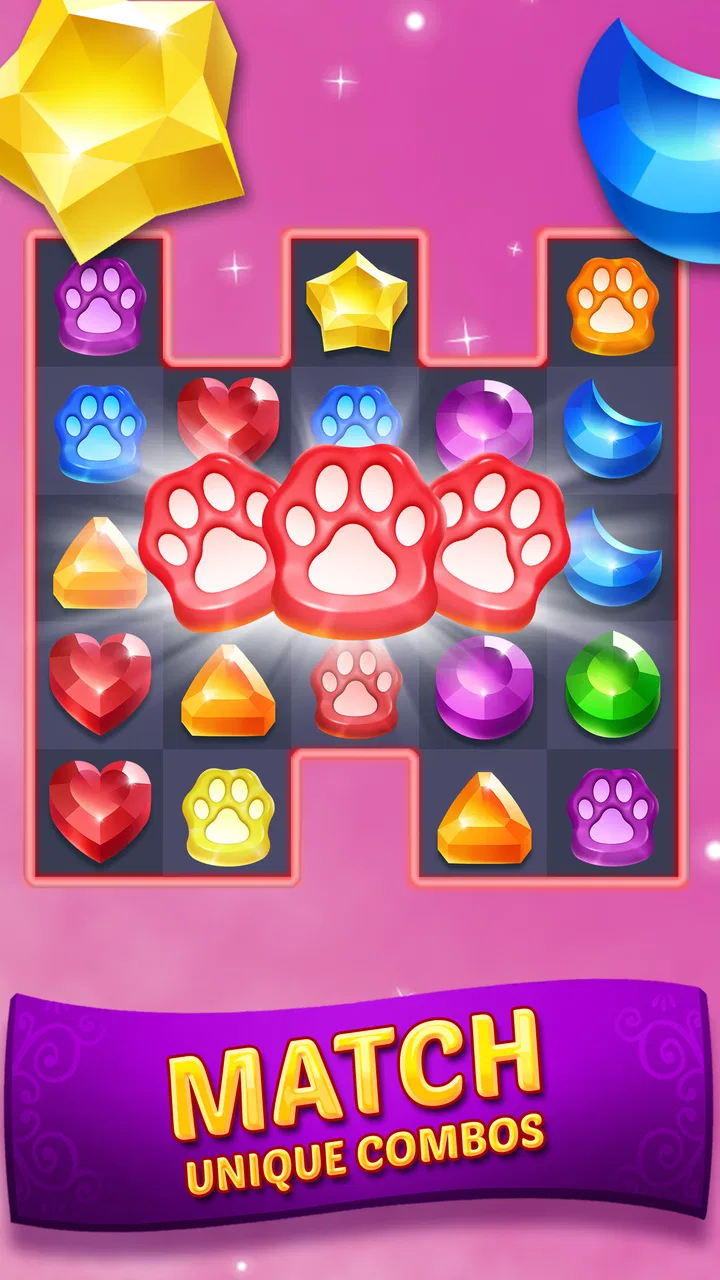
Genies & Gems - Match 3 Game
- 4.7
- Rating
- 10.00M
- Installs
- Free
- Price

 Analysis by App-foxy
I approached Genies & Gems as the kind of puzzle game I could open for a few minutes without needing a long explanation. That first impression is accurate: it is a free match-three game from Jam City, Inc. built around swapping gems, clearing matching groups, and working through puzzle stages. The magical theme gives the familiar format a little personality, while the short-level structure makes it easy to fit into a commute, a coffee break, or the few minutes before bed.
The important thing for a first-time player is that the game does not ask you to understand a complicated system before you can enjoy it. You begin by looking for simple matches, learning how the board reacts, and gradually noticing that the best move is not always the most obvious one. I found that early learning curve reassuring rather than overwhelming. The game starts with the basic pleasure of making pieces disappear, then gives you reasons to think one move ahead.
It is listed as a puzzle game for Everyone, and that description fits the accessible presentation. The colorful board and magical setting are friendly, but the later challenge can still make an adult player pause before committing to a move. With a 4.7 average from around 387 thousand ratings and more than 10 million installs, it has clearly found a large audience. Those figures do not guarantee that every player will enjoy its progression, but they do suggest that the central match-three loop is easy to pick up and broadly appealing.
You May Also Like

 Pandora - Music & Podcasts
Pandora’s Music Is Easy to Start, but Harder to Recover
Pandora’s strength is its low-effort path from a seed to a station. Its weak spot is how much confidence it asks you to place in connection, setup, and quiet recovery.

 AccuWeather: Weather Radar
AccuWeather Review: A Quick, Clear Forecast for Everyday Decisions
For everyday plans, the best forecast is the one you can understand quickly. AccuWeather makes rain timing, radar, and local conditions easy to act on, with a few trade-offs.

 Hill Climb Racing
Why Hill Climb Racing Still Turns Crashes Into One More Run
A tiny car, a bumpy hill and one more upgrade: Hill Climb Racing keeps resurfacing because its simple chaos makes every near-miss feel personal.

 AliExpress - Shopping App
AliExpress Makes Global Shopping Feel Personal, but Shoppers Bear the Risk
AliExpress turns a global marketplace into a pocket-sized discovery engine. Its reach is useful, its shopping loop compelling, and its trade-offs easy to miss.

 Lords Mobile: Kingdom Wars
Lords Mobile Is a Kingdom-Building Routine, Not a Quick Match
A case-by-case verdict on the building, battles, device demands, and social commitments that make Lords Mobile rewarding for some players and exhausting for others.

 PDF Scanner app - TapScanner
TapScanner Makes Paperwork Easier to Capture, Check, and Share
TapScanner makes scanning with a phone feel less like a rescue operation and more like a dependable step in getting work done. Its capture tools are useful, though not flawless.
More From Our News Desk
View All News


Starting smoothly and finding the first satisfying win
I like how quickly the first few boards let me settle into the game: I can learn by watching how a swap changes the gems rather than stopping to study a manual. That ease makes the first win feel satisfying without demanding a long session, and it sets up a useful question for the next stretch: how much thought does each brief visit actually need?
What to expect when you open the game
My advice is to treat the opening stages as a tutorial you play rather than read. The board communicates most of what matters through movement and visual feedback. Look for two matching gems that can be brought together by a swap, then check whether that move creates a larger group or opens space for another match. At first, the simple match is enough. The useful habit is to pause for a second before touching the screen, because a quick move can remove the chance to create a more valuable chain.
The magical presentation helps keep the early lessons from feeling dry. Instead of staring at an abstract grid, you are moving through a world with a clear puzzle identity. I would not choose this game for a deep story or a role-playing experience; its main purpose is still matching gems. However, the setting gives the repeated boards a more inviting frame than a completely plain puzzle interface.
The game is free to download, so it is easy to test without making an immediate purchase. That also means I would begin with the expectation that optional spending may become part of the experience. The listed in-app purchase range runs from $0.99 to $119.99 per item, which is a significant spread. I recommend playing through the opening section before deciding whether the game deserves any money from you. The free start is enough to judge whether the controls, pacing, and visual style suit you.
The first setup is mostly about learning the board
There is no need to rush through the first few puzzles. I used them to establish a repeatable routine: scan the whole board, identify the most promising match, make the swap, and then watch the result before choosing again. That last part matters. New gems can fall into place after a clear, and an automatic follow-up match may appear. If you immediately tap again without observing the board, you can miss a stronger opportunity.
A helpful beginner approach is to work from the lower part of the board when several moves look equally safe. Clearing lower gems can change more of the grid above them, while a match near the top may have a smaller effect on the rest of the layout. This is not a promise that every lower move is best, but it is a practical way to search for chain reactions instead of solving only the most visible pair.
I also recommend keeping your first sessions short enough to notice how your attention changes. Match-three games are simple to operate, but repeated boards can encourage automatic tapping. When I slowed down, I made fewer careless moves and understood the puzzle goals more clearly. When I played while distracted, the game became much more dependent on luck from the falling pieces. The controls are easy; careful decision-making is where the real improvement comes from.
Your first meaningful success comes from planning one move ahead
The first satisfying breakthrough is not merely completing a board. It is spotting a move that creates a second opportunity immediately afterward. For example, you may see a match that clears a path and exposes gems that were previously blocked from consideration. Instead of focusing only on the current group, ask what the board will look like after the swap. That small change in thinking makes the game feel more like a puzzle and less like a sequence of random taps.
When a level gives you a specific objective, I found it useful to prioritize that objective even when another match looks more attractive. A large clear can be visually rewarding but unhelpful if it does not advance the required task. In practical terms, I first looked for moves that affected the target, then used the remaining space to create follow-up matches. This is one of the most useful habits to learn early because it prevents wasted turns.
Another good beginner rule is to avoid spending a helpful move simply because it is available. If the board contains a potential setup for a larger combination, preserving it for one turn can be better than taking the immediate small match. This requires patience, especially when the game makes every possible move look tempting. I would not overthink the earliest boards, but I would use them to practice recognizing future possibilities.
Common confusion: a clear board is not always a successful board
New players can easily assume that removing the largest number of gems must be the correct choice. In my experience, that is the most common source of frustration. A board may look dramatically cleaner while the actual level objective remains mostly untouched. The better question is not “Which move removes the most?” but “Which move helps the goal and leaves the best next position?”
It is also easy to mistake a lucky cascade for a repeatable strategy. Falling gems can produce unexpected matches, and those moments feel rewarding, but they are not always something you can control. I treated cascades as a bonus rather than the foundation of my plan. When the board did not cooperate, I returned to the basic process of checking the objective, searching for useful positioning, and avoiding impulsive swaps.
Another point worth understanding is that difficulty can feel uneven. A stage may seem effortless after a few fortunate falls, while the next attempt feels much less generous. That does not necessarily mean your technique has suddenly failed. Match-three boards combine planning with the arrangement of available pieces, so some variation is part of the format. If I became stuck, I found it more productive to change my opening approach than to repeat the same first move automatically.
A realistic everyday session
Imagine opening the game during a ten-minute wait. You can complete a short puzzle, or at least make meaningful progress, without committing to a long story sequence or a complicated team setup. I would begin with sound or notifications adjusted to my surroundings, then play the first board slowly enough to identify its objective. If I had only a couple of minutes left, I would avoid starting a stage that required concentrated attention and instead stop after a natural pause.
That flexibility is one of the strongest reasons to try it. The game works well for people who want a focused distraction rather than a large virtual world demanding daily management. It is also suitable for sharing the basic idea with a younger player because the age rating is Everyone and the central action is immediately understandable. I would still encourage an adult to manage any purchasing decisions, particularly because the available in-app items extend from small amounts to a much higher top price.
For me, the less successful everyday scenario is playing while multitasking. If I am answering messages or watching something else, I make poorer choices and get less satisfaction from the puzzle. The game is easy to control with one hand, but that does not mean it is always enjoyable in the background. Its best use is as a small moment of attention, not as something I leave running while doing three other tasks.
What to do when progress slows
When a board becomes difficult, I would not immediately assume that spending is the answer. First, replay your decision process mentally. Did you focus on the stated objective? Did you take the first available match instead of preparing a stronger one? Did you clear the wrong side of the board? Those questions often reveal a practical adjustment. A slower, more deliberate opening can be more valuable than a quick attempt driven by habit.
I also found it useful to change the order in which I inspect the board. On one attempt, I searched for matches that affected the objective. On another, I looked for moves that opened the most space. Comparing those approaches can show which type of opening gives the board more potential. This is a simple experiment, but it turns a frustrating loss into information you can use on the next try.
Players who dislike waiting or repeating a puzzle should think carefully about whether this is the right match-three game for them. The familiar format can become repetitive if you want constant novelty, a strong narrative, or direct competition against other players. In those cases, a story-heavy puzzle adventure or a purely score-based title may be a better fit. I would choose this one for its approachable rhythm and magical atmosphere, not for deep customization or a complex strategic layer.
How it compares with familiar alternatives
Compared with a very traditional match-three game, this title feels more characterful because the gem swapping is wrapped in a magical world rather than presented as an isolated score exercise. That makes the progression easier for me to return to, especially when I want a light adventure feeling without learning an entirely new control scheme. The trade-off is that the core action remains recognizably match-three, so anyone hoping for a radically different puzzle system may find the novelty limited.
Compared with minimalist puzzle apps, it offers more atmosphere and a stronger sense of moving through stages. A minimalist alternative may be better if you want quiet concentration, fewer visual distractions, or a purely abstract challenge. Compared with competitive puzzle games, Genies & Gems is a more relaxed choice for players who do not need live opponents or leaderboards to stay interested. Its appeal depends on enjoying the journey through individual boards rather than proving a result against someone else.
The developer, Jam City, Inc., has kept the entry point broad: the game is free, rated Everyone, and supports devices running Android 7.0 or later. The current version is 62.124.101-07281013. For a first-time user, the practical takeaway is to check device compatibility before installing and then spend enough time with the early puzzles to see whether the presentation feels comfortable on your screen. The version detail is useful when troubleshooting an update or confirming that you are running the current release.
Who will enjoy it, and who should skip it
I would recommend it to someone who likes familiar match-three controls but wants a little more personality than a plain grid. It is especially suitable for casual sessions, players who enjoy gradually improving their board awareness, and families looking for an accessible puzzle format. The first meaningful success arrives quickly because the basic action is clear, but there is still room to develop better habits around objectives, cascades, and positioning.
I would be more cautious about recommending it to players who strongly dislike in-app purchases, repeated attempts, or any possibility that progress may feel slower than expected. Even though the game is free to start, the purchase range means budget-conscious users should decide in advance that they will play without buying anything, or set clear limits. I would also point dedicated puzzle purists toward a less themed alternative if they want every element stripped back to pure logic.
My next-step advice after the first few boards
Once the opening stages feel comfortable, stop treating every move as an isolated match. Start building a quick mental checklist: identify the objective, scan for the move that advances it, look for a follow-up match, and only then consider a move that simply clears space. This takes seconds once practiced and makes the later boards feel more manageable without turning the game into homework.
If you are deciding whether to keep it installed, give yourself a fair test across several short sessions rather than judging it from a single lucky win or frustrating loss. Notice whether you enjoy planning, whether the magical presentation keeps the boards inviting, and whether the pacing suits the amount of time you normally have. I would also play without purchases at first, because that gives you the clearest view of the basic experience.
My final impression is that Genies & Gems succeeds as an approachable, polished-feeling match-three option with enough strategic detail to reward attention. It is not the best choice for someone seeking a radically new puzzle mechanic or a competition-focused game, but it is easy to begin, pleasant to revisit, and capable of making a short break feel purposeful. If you enjoy colorful gem puzzles and are comfortable setting your own boundaries around optional spending, it is a sensible free game to try.
FAQs for Genies & Gems - Match 3 Game
01What is Genies & Gems - Match 3 Game?
Genies & Gems is a match-3 puzzle adventure in which you swap colorful gems to create combinations, complete level objectives, and help a genie recover stolen treasures. The game combines traditional matching mechanics with a light story, animated characters, boosters, and a large collection of stages. It is designed for casual play, although later levels can become considerably more challenging.
02How do you play Genies & Gems, and is it suitable for beginners?
The basic gameplay is easy to understand: match three or more gems of the same color by swapping adjacent pieces. Larger matches create special gems or power-ups that can clear rows, columns, or larger areas. Each level may have different goals, such as removing obstacles or collecting specific items. The early stages act as a tutorial, making the game accessible even to players new to match-3 puzzles.
03Can Genies & Gems be played offline?
Many individual levels can generally be played without a continuous internet connection once the game has loaded the necessary content. However, an internet connection may be required for downloading updates, synchronizing progress, receiving certain rewards, viewing advertisements, or accessing events and other online features. Offline availability can vary by device and version, so players should not assume that every function will work without internet access.
04Is Genies & Gems free to download, and does it include in-app purchases?
Genies & Gems is free to download, but it uses optional in-app purchases. Players may be offered extra lives, boosters, coins, or other items that can help them progress more quickly, especially when a difficult level requires several attempts. The game can be played without spending money, although patience is often necessary because lives and some resources may be limited.
05Are there advertisements or age-related considerations in Genies & Gems?
The game may display advertisements, particularly between levels or when players choose to watch a video in exchange for a bonus. It is generally suitable for casual and family-friendly puzzle gaming, but parents should review the store rating, advertising practices, and purchase settings before allowing children to play. Device-level parental controls can help restrict accidental purchases and manage screen time.
Pros
- Bright
- polished visuals make the board easy to read and enjoyable to play.
- Short levels are convenient for quick sessions during commutes or breaks.
- New obstacles and objectives keep the match-3 formula from feeling too repetitive.
- Character animations and playful effects give the game a lively personality.
- Offline play is useful when you have limited or no internet access.
Cons
- Lives can run out quickly
- interrupting play when you are on a winning streak.
- Later stages may require repeated attempts or carefully planned moves.
- Boosters can make difficult levels feel more dependent on limited resources.
- Frequent events and rewards may encourage regular check-ins and longer sessions.
- The game takes considerable storage space after updates and downloaded content.

Genies & Gems - Match 3 Game
Gallery